Case 07 — Beam with an elastic hanger under multiple concentrated loads
A timber beam is supported at both ends and subjected to two vertical concentrated loads. At an intermediate point, the beam is connected to a vertical steel hanger rod anchored to an overhead support. The vertical displacement of the connection point, support reactions, and axial force in the hanger are evaluated. This verification case validates the interaction between beam and truss elements in a composite structural system, including the correct calculation of displacements, support reactions, and internal forces.
Description
Consider the composite structure shown in the figure. A 15-m timber beam (cross-section 15×20 cm) is supported at points A and E. Two vertical loads act on the beam: 6 kN at point B and 2.4 kN at point D. At point C, the beam is connected to a 12-mm diameter steel rod, 12 m long, which is anchored to an overhead support at F.
Determine:
- The vertical displacement of point C
- The support reactions at A and E
- The axial force in the hanger rod
Structural scheme
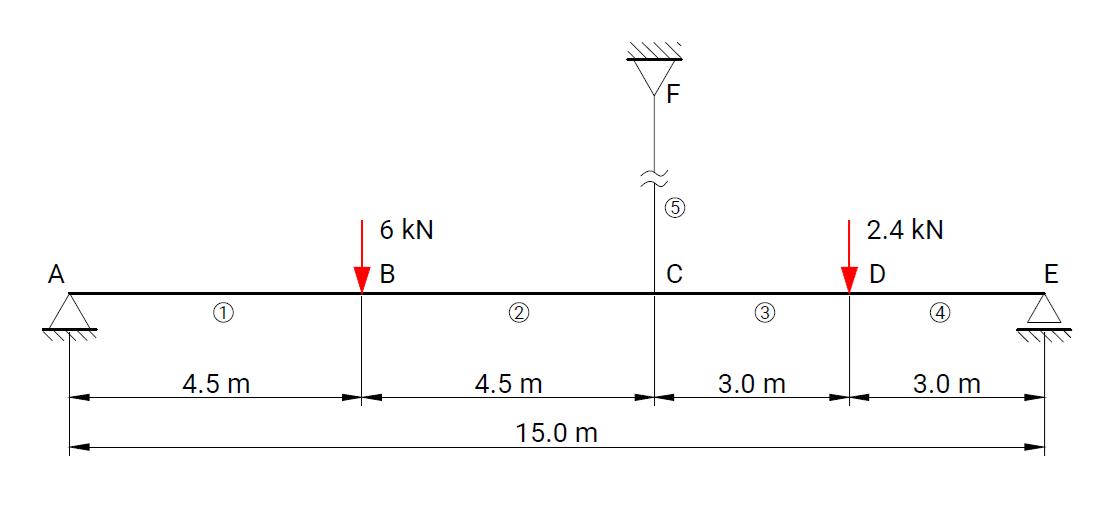
Geometry, boundary conditions, and load applications used in the verification model.
Model parameters
| Parameter | Value |
|---|---|
| Element type | Beam element, truss element |
| Material | Steel, 2.0 × 10⁸ kN/m²; Timber, E = 1.0×10⁷ kN/m² |
| Section properties | Timber beam: 0.15×0.20 m; Hanger: Ø0.012 m |
| Boundary conditions | Node A – pinned; Node E – roller; Node F – pinned |
| Loads | Nodal load −6 kN at node B; −2.4 kN at node D |
Numerical results
Displacements

Table results from RodX

Comparison of deformations (mm)
| Node | Analytical solution | RodX |
|---|---|---|
| Δy(C) | −3.256 | −3.256 |
Comparison of axial force (kN)
| Rod | Analytical solution | RodX |
|---|---|---|
| 5 | 6.137 | 6.137 |
Comparison of support reactions (kN)
| Node | Analytical solution | RodX |
|---|---|---|
| A | 2.225 | 2.225 |
| E | 0.0377 | 0.0377 |
The numerical results obtained with RodX are in agreement with the analytical solution.
Reference
- C.K. Wang, Intermediate Structural Analysis, McGraw-Hill, 1985, p. 586.